

INDUSTRY INSIGHTS
ANALYSIS & PERSPECTIVES ON SPORTS MEDIA, VIEWERSHIP, AND DATA-DRIVEN STRATEGY
The Hidden Power of Scheduling: What the ACC’s 2025 Tiebreak Reveals
12/05/2025

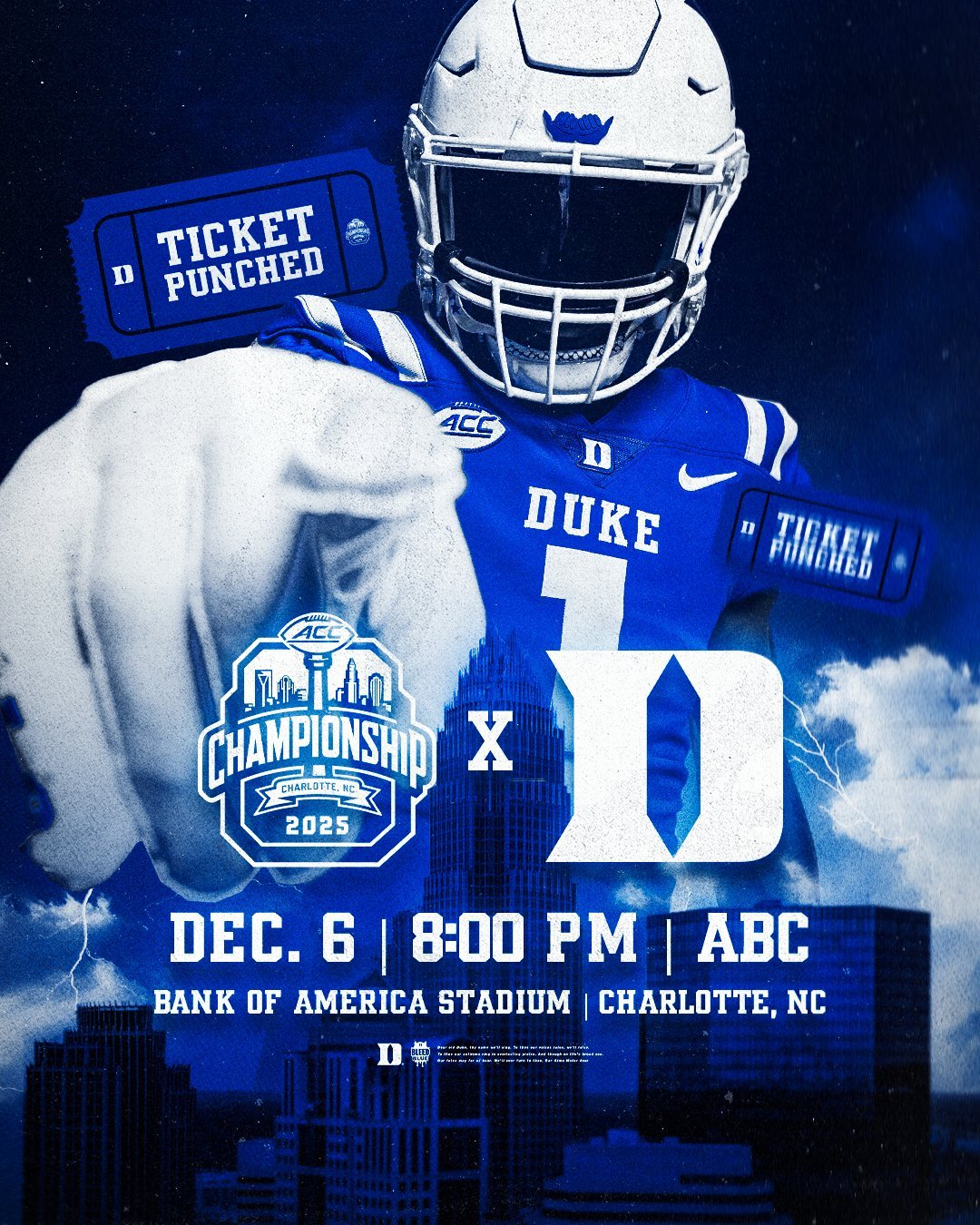
This year’s ACC football season delivered one of the most complex and consequential tiebreak scenarios in recent memory. Five programs — Miami, SMU, Pittsburgh, Georgia Tech, and Duke — all finished 6–2 in conference play. Each had meaningful wins, strong performances, and compelling arguments for why they belonged in the ACC Championship Game.
And yet, only one of them — Duke — advanced.
The determining factors had little to do with late-season momentum or standout performances. Instead, the outcome was dictated by the structural mechanics of the ACC’s tiebreak policy and the schedule rotation assigned to each team at the start of the year.
The Tiebreak Process
Because a five-team tie is rare, many fans (and even administrators) don’t regularly encounter the full tiebreak protocol. The ACC’s process includes the following steps:
Head-to-head results among tied teams (if all tied teams played each other)
A team that defeated all other tied teams
Elimination of any team that lost to all others
Win-percentage against all common opponents
Win-percentage against common opponents in order of finish
Combined win-percentage of all conference opponents
The tied team with the highest ranking by the Team Ranking Score metric provided by SportSource Analytics following the conclusion of regular season games
Chosen by a draw by the Commissioner, if still unresolved
In 2025, Steps A-D failed to separate the five teams. They did not all face each other, no team swept the group, and they did not share enough common opponents for meaningful comparison.
ACC TIEBREAKER BREAKDOWN
Step A: Head-to-Head Competition (If All Tied Teams Are Common Opponents)
Result: Step does not apply.
The five tied teams — Duke, Miami, SMU, Pittsburgh, and Georgia Tech — did not all play one another during the 2025 ACC season.
Because the ACC requires all tied teams to have played each other for Step A to be used, this step is immediately bypassed.
Duke did not play Miami or Pittsburgh.
Miami did not play Pittsburgh or Georgia Tech.
SMU did not play Duke or Georgia Tech.
Since the full round-robin condition was not met, no comparative head-to-head win-percentage exists, and Step A cannot be applied.
Step B: A Team That Defeated All Other Tied Teams
Result: No team meets this condition. No team is eliminated under B-i.
To advance under Step B, one team must have defeated every other tied team it played. That did not occur:
Duke did not play three of the tied teams (Miami, Pitt, SMU).
Miami lost to SMU and did not play Pitt or Duke.
Pittsburgh did not play Miami or Duke.
Georgia Tech lost to Pitt and did not play SMU.
SMU did not play Duke or Georgia Tech.
Since no team swept the tied group, Step B cannot identify a representative.
Step B-i: Elimination of a team that lost to all other tied teams
This scenario also does not apply — no team played all four peers, meaning no team could mathematically “lose to all others.”
Thus, the tie persists, and all five teams advance to Step C
Step C: Win-Percentage Against All Common Opponents
Result: Step cannot be applied. No meaningful set of common opponents exists across all five tied teams.
This requires the tied teams to share at least one opponent that all five played.
In 2025, because the ACC is divisionless and teams rotate opponents, the five tied teams do not share a uniform set of opponents.
Duke, Miami, SMU, Pitt, and Georgia Tech do not have a single conference opponent played by all five.
Even pairwise, overlap is inconsistent — some teams share two opponents, others share none.
Because the rule requires evaluating all common opponents among the tied teams, and that set is effectively empty, Step C cannot be applied.
Step D: Win-Percentage Against Common Opponents in Order of Conference Finish
Result: Step cannot be meaningfully applied due to insufficient shared opponents.
Step D is a deeper version of Step C — if the teams share some, but not all, opponents, the conference evaluates performance against those shared opponents in order of the opponents' final standings.
However:
The five tied teams do not share any common opponent as a group.
There is no opponent that appears on all five schedules.
The rule requires comparing results "against common opponents based upon their order of finish." Without common opponents, comparison is impossible.
Thus, Step D also fails to eliminate any team.
At this point, all five teams remain tied. The ACC advances the tiebreak to Step E.
Step E: Combined Opponent Win-Percentage
The tiebreak advanced to Step E: the cumulative ACC record of each team’s conference opponents.
Final numbers:
Duke: 32–32 (.500)
Miami: 29–35 (.453)
Pittsburgh: 28–36 (.438)
Georgia Tech: 28–36 (.438)
SMU: 25–39 (.391)
Although Duke may not have been universally viewed as the strongest team, their schedule rotation produced the highest opponent win-percentage. Under ACC rules, that made them the rightful championship representative.Although Duke may not have been universally viewed as the strongest team, their schedule rotation produced the highest opponent win-percentage. Under ACC rules, that made them the rightful championship representative.
WHY THIS MATTERS BEYOND THE ACC
This scenario highlights a modern reality for all expanded, divisionless conferences:
schedule design is no longer a background administrative task — it is both a competitive determinant and an economic one.
In an era of realignment, unequal rotations, and broadcast-driven calendars, conference schedules now function as strategic assets. The structure of a schedule — who plays whom, when, and in what sequence — can unintentionally reshape the competitive landscape long before any games are played.

1. Who Competes for Championships
Divisionless formats mean standings are determined by a unified table. If schedule rotations differ significantly in difficulty, teams can finish with identical records despite vastly different paths. In the ACC example:
Duke reached the championship because their opponents won more often.
Miami, Pittsburgh, SMU, and Georgia Tech were effectively eliminated by opponents they didn’t even play.
Conference titles — and College Football Playoff access — can hinge on the architecture of the schedule itself
2. Which Drives Game Viewership
Not all matchups carry equal national weight. A rotation that unintentionally reduces marquee games or clusters premium matchups on the same weekend can materially influence:
Linear TV ratings
Streaming engagement
Conference brand strength
Media rights value over time
Schedules shape the product that networks ultimately buy.

3. Exposure Distribution Across Member Institutions
The schedule determines who receives:
High-visibility windows
Primetime placements
Rivalry spotlights
Late-season competitive broadcasts
As conferences expand, these windows become more constrained. Uneven rotation cycles can unintentionally elevate some brands while suppressing others.
4. Travel Loads and Competitive Fairness
Repeated long-distance trips, compressed weeks, back-to-back road games, or mismatched rest cycles can all affect:
Athlete health
Competitive performance
Operational budgets
Institutional satisfaction
Travel inequities accumulate over time and influence competitive outcomes just as much as talent or coaching.
WHY THIS MATTERS NOW
In the ACC’s case, the schedule did not just influence competitive opportunities — It determined the championship participant. With the Big Ten, SEC, ACC, and Big 12 all operating divisionless models, the stakes of schedule design have never been higher. This is exactly the environment in which scheduling tools become essential for conferences that want to:
Understand the implications of their scheduling formats
Identify future pitfalls before they happen
Ensure fairness, exposure, and value are balanced across their membership
Present transparent, data-driven rationale behind schedule cycles
When conferences understand the long-term impact of the schedules they adopt, they gain control over a process that too often produces unintended consequences.



WHERE OPTIMATCH COMES IN
In an environment where scheduling structure directly shapes competitive access, exposure, and conference value, the need for data-driven schedule evaluation becomes undeniable. Conferences can no longer rely solely on tradition, rotation cycles, or manual modeling to understand the downstream impact of their calendars. This is exactly where OptiMatch enters the picture.
OptiMatch is CSMG’s scheduling intelligence platform built to help conferences understand, quantify, and optimize the full impact of their scheduling models — before those decisions influence competitive access, media value, or institutional equity.
Conferences increasingly recognize that schedule design is one of the most consequential levers they control. OptiMatch evaluates that impact by modeling how different scheduling formats and game configurations influence key performance indicators that define the success of the event. Our tool can provide conferences with clarity - a data-driven view of how a schedule performs before it is even announced. It does not decide competitive results, but it illuminates the structural consequences of scheduling choices so conferences can make decisions that are intentional, balanced, and strategically aligned.
The ACC example is a reminder that schedules shape outcomes long before the season begins.
OptiMatch gives conferences the tools to understand those impacts and build models that reflect competitive fairness, media value, and institutional priorities. Whether a conference is evaluating a new rotation, an expansion model, or a completely redesigned scheduling framework, OptiMatch provides the analytical foundation to do so with confidence.